
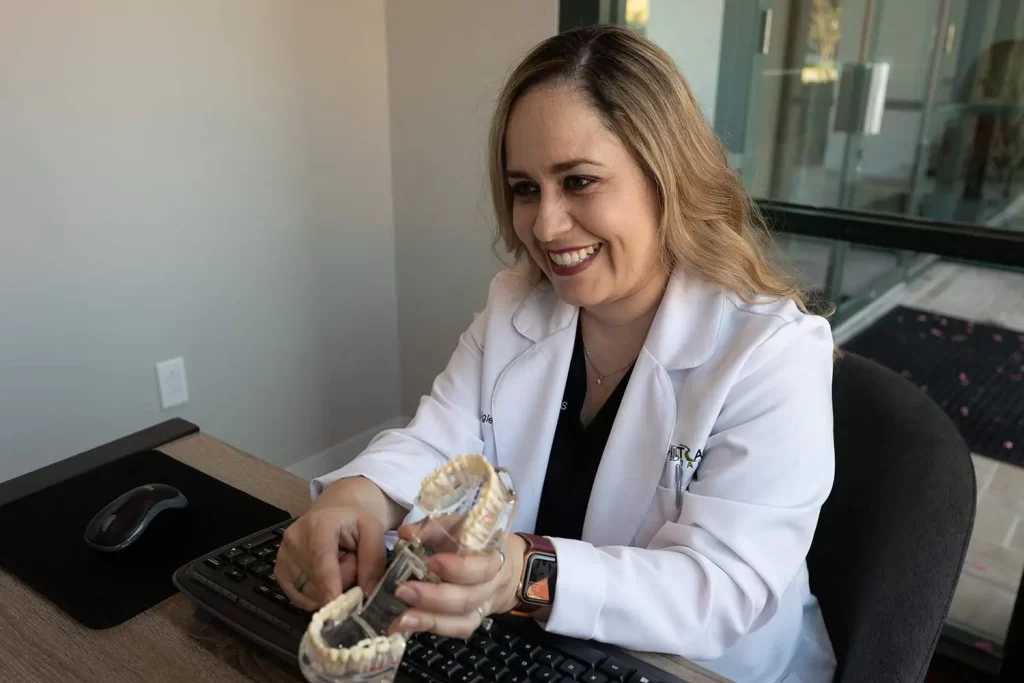
There’s a question we hear often at Off The Trace Dental in Slidell:
- “What’s actually the best option for replacing my missing tooth?”
Usually, a patient has already done some research. They’ve seen ads for dentures, heard about bridges from a friend, and maybe read a little about implants. But they’re still confused, because every option sounds reasonable until you look a little closer.
That confusion is completely normal. All three tooth replacement options, dental implants, bridges, and dentures, can replace missing teeth. But they don’t do it the same way, they don’t last the same amount of time, and they don’t feel the same in your mouth. The right choice depends on your specific situation, your bone health, your budget, and what your long-term goals are for your smile.
Dr. Pamela Daigle and the team at Off The Trace Dental have helped hundreds of patients in Slidell, Lacombe, Mandeville, and surrounding communities navigate this exact decision. Call us at (985) 326-1711 to schedule a consultation and find out which option is right for you.
The Hidden Cost of Living With a Gap in Your Smile
Many patients put off tooth replacement for months, or sometimes years. It’s understandable. Life is busy. The options feel overwhelming. And if the missing tooth isn’t visible when you smile, it’s easy to tell yourself it’s not urgent.
But your jawbone doesn’t wait. Once a tooth root is gone, the bone beneath it starts to shrink. Without stimulation from chewing forces, the jawbone gradually deteriorates in a process called resorption. Within the first year after a tooth is lost, you can lose up to 25% of bone width in that area. After three years, the loss deepens further.
That bone loss does more than affect your x-rays. Over time, it changes the shape of your face. Cheeks look hollow. The lower jaw shifts forward. Patients notice they look older than they are. not because of wrinkles, but because the underlying structure has changed. Remaining teeth also start to shift toward the gap, which creates bite problems and increases the risk of losing more teeth.
This matters when comparing your replacement options, because only one of them actually stops this process. Bridges and dentures sit on top of the gum. They restore the visible part of the tooth. But they do nothing for the bone beneath, because they don’t replace the root. Dental implants replace the entire tooth structure, including the root, and that makes all the difference for your long-term bone health.
The American Academy of Implant Dentistry reports that dental implants have a success rate above 95% over 10 years, making them the most reliable long-term solution for missing teeth. That success rate reflects something important: implants work with your body, not against it.
Three Ways to Replace a Missing Tooth
Dental Bridges
A dental bridge uses the teeth on either side of the gap as anchors. Our Slidell dentist files down those neighboring teeth, removing healthy enamel, and fits crowns over them. A false tooth (called a pontic) hangs in the middle, bridging the gap. The procedure usually takes two appointments over two to three weeks. Bridges feel natural and look good, but the trade-off is that you’re permanently altering two healthy teeth to support one replacement. They typically last 10 to 15 years before they need to be replaced, and cleaning underneath them requires special floss threaders.
Dentures
Dentures are removable appliances, either full dentures replacing an entire arch or partial dentures replacing several missing teeth. They rest on the gums and are held in place by suction, clasps, or dental adhesive. Dentures in Slidell are the most affordable upfront option and don’t require surgery. But they also require adjustment as bone loss changes the shape of the jaw; they can slip during eating or speaking, and many patients find them uncomfortable after extended wear.
Dental Implants
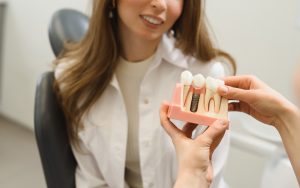
Implants are titanium posts that are placed directly into the jawbone, where they fuse with the bone over three to six months through a process called osseointegration. Once integrated, a crown is attached to the top of the implant. The result is a tooth that looks, feels, and functions like a natural tooth and can last a lifetime with proper care. The process takes longer than bridges or dentures, but most patients say that dental implants are worth the added wait.
The Honest Comparison: Implants vs. Bridges vs. Dentures
Here’s how the three options stack up across the factors that matter most to patients:
- Longevity: Implants can last a lifetime. Bridges typically last 10 to 15 years. Dentures last 5 to 10 years and require adjustments as the jawbone changes shape.
- Bone preservation: Only implants preserve jawbone. Bridges and dentures allow bone loss to continue after the tooth is removed.
- Impact on neighboring teeth: Bridges require permanently altering two healthy adjacent teeth. Implants leave neighboring teeth completely untouched.
- Diet restrictions: Dentures limit what you can eat; hard foods, sticky foods, and some raw vegetables can all be problematic. Implants have no dietary restrictions.
- Maintenance: Implants are cleaned exactly like natural teeth, and brushing and flossing are done as normal. Dentures must be removed nightly and soaked. Bridges require special cleaning tools to reach under the pontic.
- Feel and confidence: Implants feel like natural teeth and never move. Dentures can shift, click, or slip at inconvenient moments. Bridges feel fairly stable but can feel slightly bulky.
- Upfront cost: Dentures have the lowest upfront cost, followed by bridges, then implants. However, when you factor in replacement costs over 20 to 30 years, implants are often the most cost-effective long-term choice.
Why Dental Implants Are the Long-Term Investment That Pays Off
Most patients who choose implants say the same thing after the process is complete: they wish they had done it sooner. That’s not a sales pitch. It reflects what the research and patient experience consistently show. According to the American Dental Association, dental implants are the gold standard for tooth replacement because they preserve bone, maintain oral function, and prevent the shifting of adjacent teeth. No other replacement option offers all three of those benefits together.
Here’s what makes implants uniquely valuable:
- They stop bone loss at the source. The titanium post acts as a prosthetic root, transmitting chewing forces directly into the jawbone just like a natural tooth root would. Your bone stays stimulated, stays dense, and maintains the facial contours that keep you looking like yourself.
- They protect your remaining natural teeth. When a tooth is missing, adjacent teeth gradually drift toward the gap. This shifts your bite, which puts uneven stress on the teeth that remain. Implants fill the gap and keep everything in its proper position. This can prevent a cascade of dental problems down the road.
- They function without restrictions. Patients with implants eat corn on the cob, steak, crunchy vegetables, and everything else they enjoyed before they lost their tooth. There’s no mental calculation before each meal about what you can and can’t chew. For patients in Slidell who love their seafood, crawfish boils, and summer cookouts, that matters.
- They’re the lowest-maintenance option long-term. Brush, floss, and come in for your regular cleanings at Off The Trace Dental. That’s it. No adhesives, no soaking, no special tools. Many patients tell us they forget which tooth is the implant after a year or two.
If you’re replacing an entire arch of teeth, All-on-4 dental implants offer a full-arch restoration supported by just four strategically placed implants, providing a permanent, non-removable solution that avoids the challenges of traditional full dentures.
And if you’re worried about whether the procedure is right for your bone structure or health history, read about whether you’re a candidate for dental implants; the answer may surprise you. Many patients who assumed they were not candidates because of bone loss or age still qualify after evaluation.
Why Patients Across Slidell Choose Off The Trace Dental for Their Implants
Choosing where to get your dental implants is just as important as choosing the implant itself. The placement requires precision, experience, and a doctor who takes time to understand your specific anatomy and goals.
At Off The Trace Dental, patients choose us for a few specific reasons:
- Dr. Daigle explains everything, and then explains it again. No patient leaves their consultation feeling rushed or uncertain. She walks through the x-rays, the bone density, the timeline, and what the procedure will feel like at each step. Patients from Slidell, Lacombe, Pearl River, and Mandeville consistently tell us they came to us because they felt heard here after feeling dismissed elsewhere.
- We treat the whole patient, not just the tooth. If you have dental anxiety, we accommodate that. If bone grafting is needed before your implant, we coordinate the full process. If cost is a concern, we talk through financing options before you make any decision. We don’t push patients toward the most expensive option. We help them understand all of them and make the right choice for their life.
- We’re part of this community. Off The Trace Dental isn’t a dental chain or a corporate office. We’re a private practice in Slidell, and many of our implant patients are neighbors, referrals from neighbors, or people who found us because someone at their kid’s school or their church mentioned us. That kind of word-of-mouth trust means something to us, and we work hard to deserve it.
- We monitor long-term outcomes. Once your implant is placed and your crown is attached, we don’t send you off and call it done. We check on your implants at every cleaning and address any early signs of issues like peri-implantitis before they become bigger problems. Your implant is a long-term commitment from us, not just a procedure.
Patients who have already gone through the implant process at our office often say the same thing: they finally feel like themselves again. Read more about what that experience looks like in our post on how dental implants improve the quality of life for Slidell patients.
What Happens When You Come In for a Consultation
If you’re considering dental implants, your first step is a consultation with Dr. Daigle. Here’s what that visit looks like:
We’ll take a full set of X-rays and possibly a 3D cone beam scan to assess your bone density and the anatomy of your jaw. Dr. Daigle will examine your remaining teeth and gums, review your medical history, and ask about any medications you take that could affect healing.
From there, she’ll tell you exactly what she recommends and why. If you’re a good candidate for implants, she’ll walk you through the timeline, the number of appointments, and what to expect at each stage. If bone grafting is needed first to build up lost bone density, she’ll explain that too and how it factors into the overall plan.
You’ll leave the consultation with a clear picture of your options, a written treatment plan, and the cost information you need to make a decision. There’s no pressure and no rush. Some patients decide the same day. Others take a few weeks. Both are fine.
To learn more about what your implants might cost, visit our page on how much dental implants cost in Slidell, where we break down the factors that influence pricing and the financing options we offer.
Tooth Replacement Options at Off the Trace Dental
Ready to stop living with a gap in your smile? Call Off The Trace Dental at (985) 326-1711 or contact us online to schedule your implant consultation with Dr. Pamela Daigle. We serve patients throughout Slidell, Lacombe, Pearl River, Mandeville, and Covington, and we’d be honored to help you find the right solution for your smile.